DEMONSTRATION OF COORDINATED ACTION NETWORKS
A ten-community demonstration of a new political medium through which people can understand their circumstances, authorize collective action, and exercise responsibility for their common future.
What we propose to demonstrate
CAN—Coordinated Action Networks—combines community-owned communication technology with a process through which people living in geographically bounded communities can develop shared understanding, make consequential decisions, organize resources, and act effectively together.
We propose to begin in ten communities, initially in the San Diego–Tijuana region and other participating locations, with independent evaluation.
The demonstration is not principally a test of software. It tests whether the obstacles that prevent communities from exercising informed, continuing responsibility for collective power can be overcome.
How we begin
CAN begins with people, not technology.
Every community has existing relationships, organizations, interests, talents, resources, and consequential circumstances. Our first task is to bring these into a shared process through which people can discover what they want for their community and what they are capable of accomplishing together.
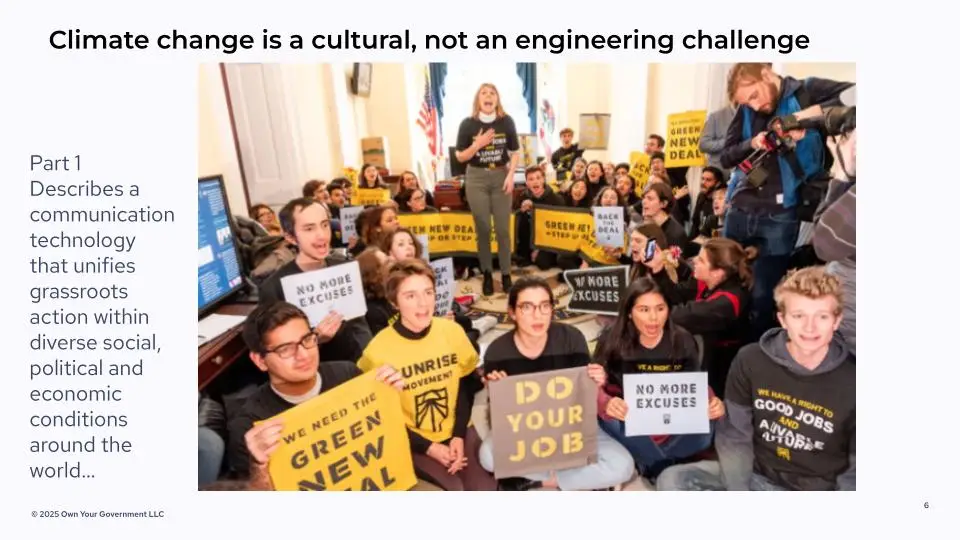
Local organizers, educators, artists, filmmakers, community leaders, professionals, and facilitators help introduce the process through cultural activities, documentary media, workshops, useful services, and ordinary community relationships.
Participation does not depend upon recruiting people who are interested in politics. It begins with the lives people are already living.
Participating residents help establish the community’s organizational structure, rules of participation, and governance. Each community retains autonomy over its priorities and decisions.
What residents actually do
Consider a community concerned about polluted water.
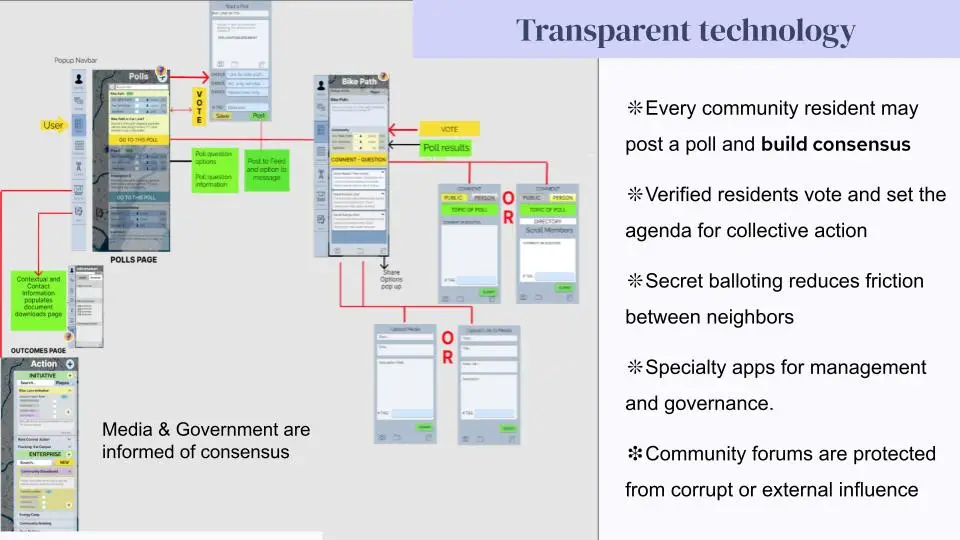
Residents use their community’s CAN app or website to register and verify residence. They bring the problem before their community, investigate circumstances, examine evidence, consult expertise, and distinguish established facts from assertions and unresolved questions.
They develop alternative proposals, challenge assumptions, negotiate differences, and establish where agreement and disagreement exist.
CAN enables the community to record what has been proposed, who participated, what agreement was established, and what disagreements remain. Participation is distinguished from nonparticipation, and agreement on one proposal does not imply authorization of another.
Residents can then authorize specific actions, responsibilities, resources, and limits.
Participants organize expertise, volunteers, money, and institutional relationships. They coordinate with other affected communities, communicate with public agencies, carry out authorized work, and document progress and results.
The process does not end with a decision. Results become part of the community’s continuing shared record, available for examination, correction, and further action.
Institutions need not originate an initiative. A community can assume responsibility for what it is willing and capable of accomplishing and request assistance where needed.
What makes CAN different
Elections, hearings, surveys, social media, and public consultation provide opportunities for participation, but they do not necessarily establish a community’s informed, authenticated collective judgment or its authorization of consequential action.
CAN is designed to provide that continuing capability.
Its value is not confined to a particular issue. The same community infrastructure supports education, healthcare, housing, environmental stewardship, economic development, recreation, emergency coordination, and other purposes residents determine themselves.
Communities may agree on particular actions while continuing to disagree on other matters. CAN preserves those differences rather than requiring uniformity.
Communities can also cooperate across geographic and national boundaries, independently authorizing shared undertakings while retaining control over their own decisions and commitments.
The technology and its development
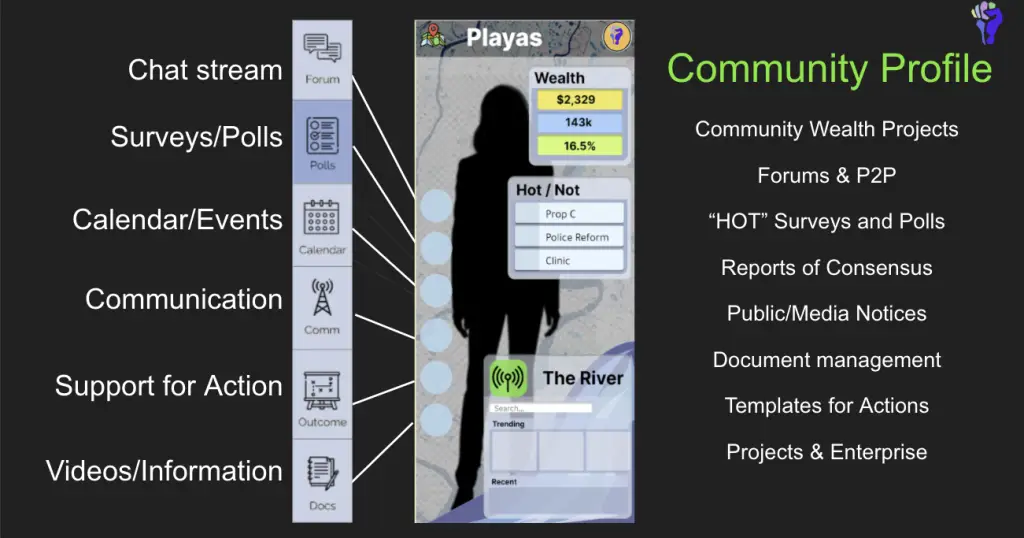
CAN’s proposed app and website provide a familiar digital environment for community information, activities, communication, shared inquiry, proposals, agreements, decisions, project management, and accountable action.
The technology is being organized around a different purpose from conventional commercial and social media: enabling people to exercise agency and responsibility rather than primarily influencing their behavior.
The architecture also anticipates cooperative partnerships with technology organizations rooted in different cultures and political environments. These organizations would help develop, adapt, maintain, and support compatible technology for autonomous communities throughout the world.
Existing designs and specifications provide a starting point. The demonstration will require development, implementation, and validation of the necessary technology and community-governance procedures.
What the demonstration will establish
Independent evaluation will examine whether participating communities can:
Attract and sustain inclusive participation through existing community life.
Develop shared understanding of consequential circumstances and examine competing evidence and proposals.
Establish and document verifiable agreement, disagreement, and explicit authorization.
Organize people, expertise, financial resources, and commitments into consequential action.
Produce and document practical results, including accountability for the people and institutions involved.
Coordinate with other autonomous communities without surrendering local authority.
The demonstration will also examine what changes in people’s willingness and capacity to assume responsibility, their relationships with one another, and their ability to influence institutional decisions.
Success will not be measured merely by the number of registered users, responses to polls, or activities on an application.
The consequential test is whether people and communities acquire a continuing capability to understand what is happening, determine what should happen, and act effectively together.
An international undertaking
The proposed ten-community demonstration is a beginning, not a geographical limit.
CAN envisions a sustainable international network of autonomous communities supported by culturally grounded, cooperating technology organizations.
The purpose is not to create a new center of political power, but to enable responsibility to develop organically among people and communities where it is needed and appropriately exercised.
We are seeking communities, organizers, technical collaborators, creative professionals, institutional partners, independent evaluators, and sponsors to undertake the demonstration.
Bring CAN to your community. Help develop and demonstrate a new medium for collective understanding, responsibility, and action.
COMMUNITY CULTURE VS. CAMPAIGN FINANCE
CONGRATULATIONS Luiz Inácio Lula da Silva!

FInanced by PACs, media typically manipulates voters. In Brazil’s presidential election this year, fan accounts for major artists such as Taylor Swift, Billie Eilish, Lady Gaga, Katseye, Demi Lovato, Harry Styles, Katy Perry and Selena Gomez ignited a movement, offering their massive platforms to amplify the current president’s campaign and help boost their access to young audiences. The quickly spreading movement began with a Billie Eilish fan account, with the singer’s famed brother, musician Finneas, posting a picture making the pro-Lula “L” sign on social media soon after. ” (Excerpt From “Lula’s Election Win: How Fan Accounts Helped Him to a Historic Victory and Defeat for Trump” — Variety)
BUT ELECTIONS DO NOT MANDATE POLICY
BETWEEN ELECTIONS
THE PUBLIC HAS NO SAY ABOUT DECISIONS
ELECTED OFFICIALS
ARE NOT REQUIRED TO ASK VOTERS HOW THEY SHOULD VOTE

“ALL POLITICS IS LOCAL”
Organized communities can benefit from relationship, common interest and alignment of intention.
Relationship is the basis of “ALL POLITICS IS LOCAL”.
CONCERNS AND ISSUES VARY WIDELY FROM PLACE TO PLACE
Values, needs and priorities vary widely.
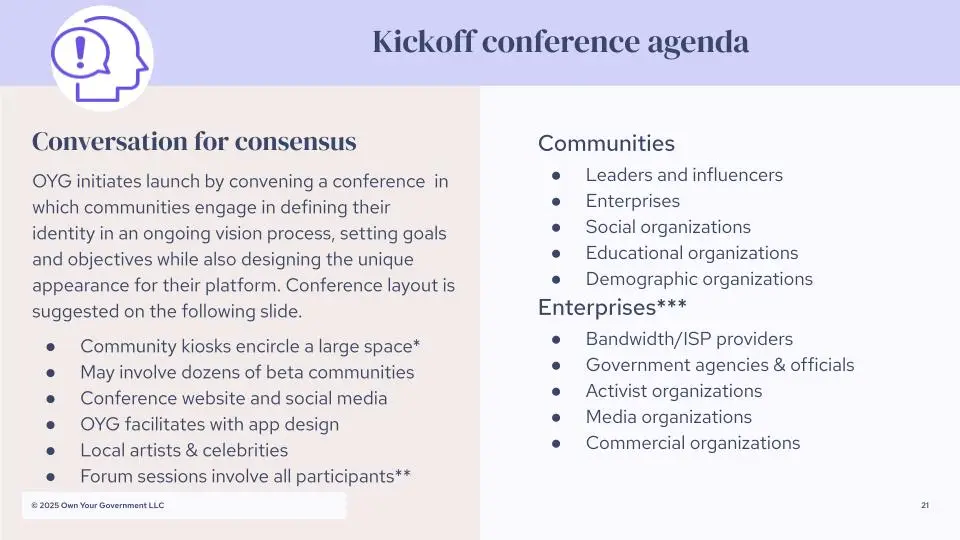
CAN gives communities a structure for self-determination of priorities
TECHNOLOGY CAN SOLVE LOGISTICS OF INCLUSION
CAN’s approach to inclusion and community adoption welcomes diversity
This will be tested and independently evaluated through the demonstration.
THE DEMONSTRATION IS NOT ONLY A TEST OF SOFTWARE
WE ARE TESTING STRATEGIES THAT REMOVE OBSTACLES TO AUTONOMOUS DEMOCRATIC COMMUNITIES
CAN IS DESIGNED TO OVERCOME SYSTEMATIC OBSTACLES
Thesse earlier Own Your Government interface and technical designs.
provided the foundation for CAN development
implementation and performance remain to be demonstrated.
GOVERNMENTS AT ALL LEVELS ARE AFFECTED:
Members of Congress, state assemblies, county supervisors and city council members
are not required to inform constituents, nor to ask constituents how they want them to vote.
AN INCREASE IN PUBLIC POWER REDUCES INFLUENCE OF PACS AND ESTABLISHED INTERESTS
Those who oppose mail-in voting, or seek to make voting more difficult, resist democratic decision-making.
OBSTACLES
POLITICAL PARTIES WILL ADDRESS A NEW LANDSCAPE
PARTIES THAT FOCUS ON MOBILIZING ELECTIONS-NOT SOLUTIONS FOR LOCAL PROBLEMS
WILL ENCOUNTER VOTERS WHO KNOW WHAT THEY WANT
LOCAL PARTY ORGANIZATIONS FOCUS ON FUNDRAISING EXCLUDE MANY
FUNDRAISING REFLECTS A COMMUNITY’S ESTABLISHED ECONOMIC HIERARCHY
PARTY PLATFORMS ARE NOT DECIDED BY ELECTED COMMITTEES AND INFLUENCED BY DONORS
FREQUENTLY ASKED QUESTIONS
Why begin with cultural participation rather than a political meeting?
RELATIONSHIP!
Is this just another way for government and advertisers to surveil us?
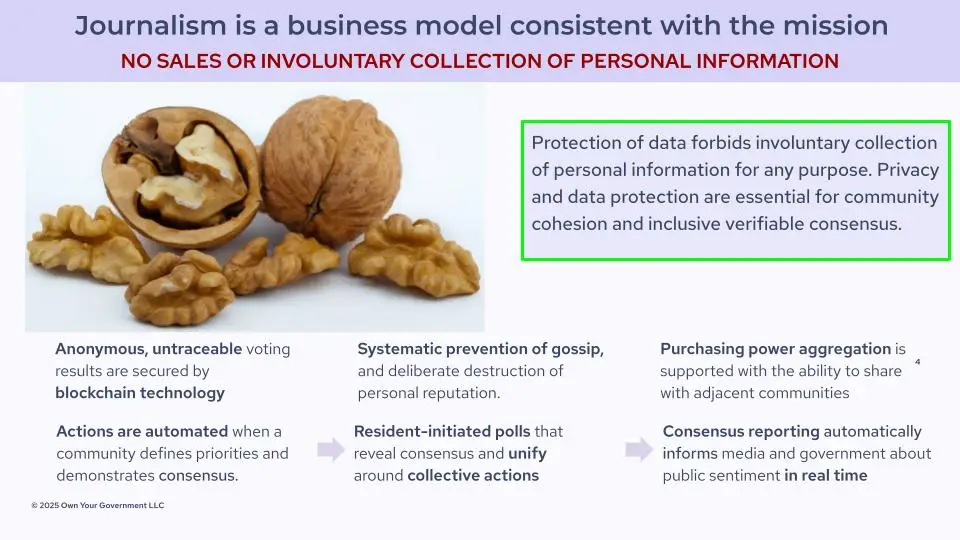
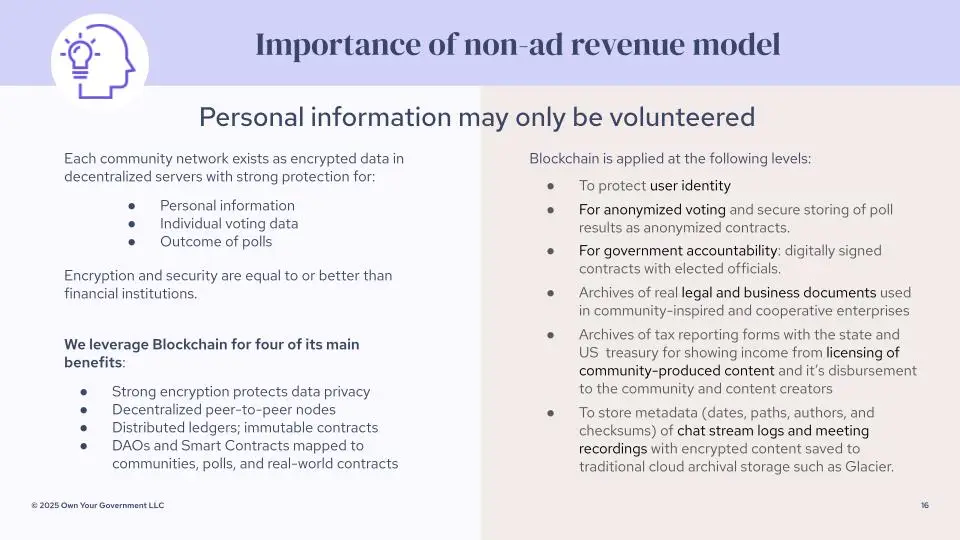
PERSONAL DATA IS SACROSANCT FOR VOTING PRIVACY
Why offer practical services before asking people to weigh in?
CAN IS A UTILITY WITH MANY APPEALING VALUES
How much is this going to cost us?
AT SCALE COSTS ARE LESS THAN $1/YEAR PER USER
Why preserve disagreement rather than force agreement?
UNITY IN DIVERSITY MUST BE VOLUNTARY
Why organize geographically bounded communities?
COMMON CONCERNS, INTERESTS AND RELATIONSHIP
Why require local autonomy instead of one central platform?
SECURITY AND INSULATION FROM EXTERNAL INFLUENCE
Why create a durable public record?
TRANSACTIONS, ACCOUNTABILITY, MANAGING COMMITMENTS
Why involve artists, filmmakers, teachers, businesses, professionals, institutions and ordinary residents?
COLLECTIVE POWER IS GREATER THAN.THE SUM OF PARTS
Why make the system useful even when no political question is being decided?
COLLECTIVE RESOURCES ARE PRACTICAL
AND SUPPORT ENTERPRISES AND SOLUTIONS