DEMONSTRATING COORDINATED ACTION NETWORKS
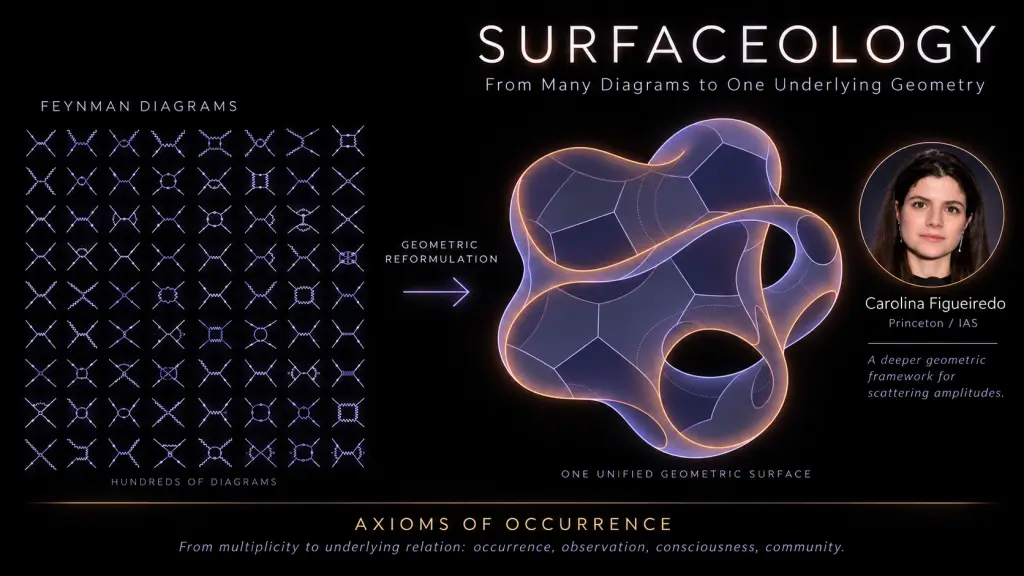
The surfaceology graphic (above) represents a useful way of thinking about CAN.
Carolina Figureire, a doctoral candidate at Princeton noticed that different particle theories share a geometric structure that is much simpler than the calculations traditionally used to describe them, revealing the geometry of the quantum universe.
CAN asks a similar question about democracy: beneath the phenomena of elections, hearings, polls, campaigns, parties and media, is there an underlying structure through which people understand their shared conditions and connections, form judgments, establish agreement about action, and act collectively?
Carolina’s graphic is analogy for CAN in breaking new ground, not by improving existing procedures; but by testing an architecture for democracy that has been hidden by legacy conventions.
THE REASON WHY WE SAY, ALL POLITICS IS LOCAL
OBSTACLES TO DEMOCRACY IN AMERICA
POLITICAL PARTIES ARE THE INTERFACE BETWEEN LOCAL ORGANIZATION AND NATIONAL DECISION-MAKING
PARTIES EXCLUSIVELY FOCUS ON MOBILIZING ELECTIONS-INSTEAD OF SOLUTIONS TO PROBLEMS
LOCAL PARTY ORGANIZATIONS EXCLUDE MOST OF THE COMMUNITY.
LOCAL PARTY ORGANIZAtIONS ARE FUNDRAISING AND REFLECT THE COMMUNITY’S ECONOMIC HIERARCHY
AS A RESULT, THE PUBLIC CAN’T WEIGH IN BETWEEN ELECTIONS-AND ELECTIONS DO NOT MANDATE POLICY
CONSEQUENCES OF DECISIONS MADE FOR PACs ARE EXISTENTIAL RISKS:
Global warming: effects of climate change.
Vulnerabilitiy to natural and engineering catastrophes
Warfare
Economic depression.
Pandemic
Insufficient infrastructure
Conflict, crime and violence
THE PUBLIC IS EXPOSED TO EMOTIONALLY SEDUCTIVE TARGETED MEDIA
GOVERNMENT AT EVERY LEVEL IS AFFECTED:
Members of Congress, state assemblies, county supervisors and city council members are not required to inform constituents or to determine what the public wants.
ANY INCREASE IN PUBLIC POWER iREDUCES THE INFLUENCE OF PACS.AND ORGANIZED INTERESTS
Those who now oppose mail-in voting, and who are making voting more difficult oppose a democratic solution
CAN BRINGS COMMUNITIES TOGETHER TO OVERCOME PACS
The collective agency of organized communities is not asserted nor prohibited by state or federal.law
Technology overcomes logistical difficulties, we have the expertise and a legal structure based on cooperatives.
CAN has a sophisticated approach to motivating adoption of the technology.
Values, needs and priorities differ widely from place to place but people in communities have social solutions.
The ability of media to maniputate voters has been dominated by PACs but a community has an edge: a declaration of common interest and intention for its members. Common fate and common intention are the reason why we say, “ALL POLITICS IS LOCAL”.
THE GREATEST CHALLENGE TO DEMOCRACY IN AMERICA IS OUR LOCAL HEGEMONIES.
THE DEMONSTRATION IS DESIGNED TO MEET THAT CHALLENGE
Parts of the CAN strategy may seem superfluous, inefficient, and counter-intuitive if we viewed CAN as software development: community outreach, political organization, project management and cultural and sport events.
But viewed as solutions to the actual obstacle-local hegemonies, habitual practices, misinformation in media, bribery, illiteracy, lack of political and econmic sophistication, racism, sexism and agism, etc. they make perfect sense.
Why begin with cultural participation rather than a political meeting?
Is this ja a way for government tp surveil us?
Why establish practical services before asking people to weigh in
Specially when it going to cost them.
Why preserve disagreement rather than force agreement?
Why organize geographically bounded communities?
Why require local autonomy instead of one central platform?
Why create a durable public record?
Why involve artists, filmmakers, teachers, businesses, professionals, institutions and ordinary residents?
Why make the system useful even when no political question is being decided?